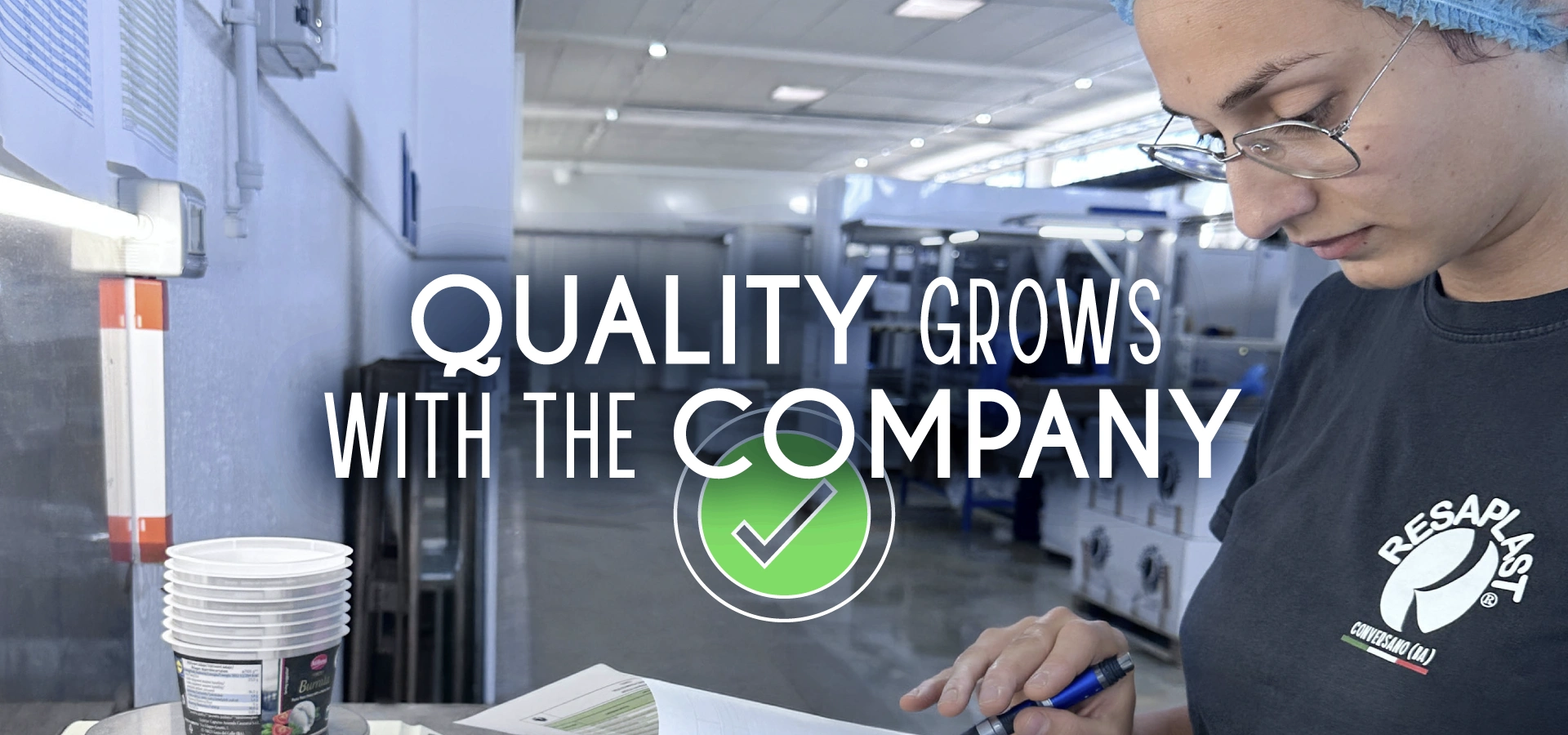
In food-contact packaging, quality goes far beyond simply checking the finished product. It is the result of a system involving people, processes, checks and documentation, designed to ensure safety, compliance and consistency at every stage.
For Resaplast, joining the Sunino Group, a company specialized in plastics processing and moulding, has provided an opportunity to strengthen this approach and progressively develop a more structured quality framework.
We spoke to Dr Solive, Head of the Sunino Group’s Integrated Management System, to understand the key areas in which the company’s Quality System will continue to evolve.
Dr Solive, what were the main changes introduced at Resaplast in terms of quality following its integration into the Sunino Group?
“This is a medium- to long-term process that has first and foremost involved strengthening the organisation dedicated to quality and food safety. New roles with specific responsibilities for quality and process control have been introduced, complementing the expertise already in place with new professionals. Expanding the team has allowed us to increase the level of attention and oversight devoted to quality activities, while building on an already solid foundation and staff with significant experience in the production process.”
The strengthening process has therefore involved not only additional resources, but also a clearer distribution of responsibilities and greater specialisation of expertise. This development goes hand in hand with Resaplast’s production and commercial growth and with its engagement with increasingly structured customers.
“One of the most significant changes has been the stronger focus on process controls. Today, dedicated quality control personnel are present across all shifts. At the same time, we have introduced a new role currently undergoing specific training in document management and certification requirements. This allows us to distribute activities more effectively and strengthen both the operational and documentary aspects of the system.”
The aim is to shift the focus increasingly from the sole inspection of the finished product to continuous process monitoring, allowing any anomalies to be identified promptly while also making document and regulatory management more structured.
What are the main analytical tests required for food-contact packaging?
“A significant part of the testing is carried out by accredited external laboratories, depending on the analyses required, such as migration and microbiological testing. The results, together with the required documentation, are essential for preparing and issuing the relevant declarations of compliance.”
A structured Quality System also requires its effectiveness to be assessed regularly. This is why audits are an essential tool: they make it possible to verify that procedures are being implemented, identify any critical issues and define the actions needed for improvement.
How is the audit system currently structured at Resaplast?
“We have several levels of verification, ranging from internal hygiene audits carried out by the personnel responsible for process quality control to audits conducted by an external consultant, who provides an independent perspective. These are complemented by audits carried out by certification bodies, which verify compliance with the requirements of the relevant standards.”
The approach is therefore based on multiple levels of control, combining internal expertise with independent assessment.
What is changing specifically in terms of certifications?
The integration with the Sunino Group also involves the standards underpinning the management systems.
“The process we are currently pursuing primarily involves aligning Resaplast’s standards with those already adopted by Plastic Legno. For ISO 9001, the certification is due for renewal by the end of the year, while in the area of food safety we have started the process of obtaining FSSC 22000 (Food Safety System Certification), a GFSI (Global Food Safety Initiative)-recognised standard that combines the requirements of ISO 22000 with additional elements specifically focused on food safety management.”
Quality is not measured solely by what happens inside the production facility. For companies operating in food-contact packaging, compliance, traceability and the availability of documented evidence are an integral part of the product’s value.
How important has this aspect become for Resaplast and its customers?
“Increasingly so. Meeting new regulatory requirements, such as those arising from the European PPWR framework, involves more than simply collecting documentation provided by our suppliers. It also requires supporting technical documentation and analytical reports needed to demonstrate compliance. This is a significant undertaking in terms of checks, testing and dedicated resources, and it is now a fundamental pillar of our Quality System.”
Regulatory compliance therefore also becomes an element of reliability in the customer relationship, ensuring that customers have access to the information and supporting evidence they need to verify packaging compliance.
Are there any developments planned in terms of traceability?
“Yes. An important digitalisation project is currently under way. Plastic Legno already uses SAP management system, and meetings have also begun at Resaplast to implement it, with go-live scheduled for early 2027. The system will allow traceability to be managed through the information system, tracking the material through to the finished product and, in the opposite direction, from the finished product back to the original raw material. Digitalisation will make the process more structured, faster and easier to access.”
The project represents another step towards an integrated system capable of connecting raw materials, production and finished products while making data management more efficient.
Integration into the Sunino Group has also brought increased investment in training and knowledge sharing, with the aim of building shared expertise across the different companies.
How has this process encouraged the exchange of expertise between the different companies within the Group?
“Resaplast’s quality team has had the opportunity to work directly with the Group’s headquarters in Piedmont, taking part in training sessions. Together with Resaplast, we are developing a growth model based on knowledge sharing, in which expertise and experience gained in different environments become a shared asset.”
This synergy reflects the true purpose of this journey: strengthening the Quality System means investing in the people, processes and tools that make it possible to manage them effectively. For Resaplast, quality is not a destination, but a system that continues to evolve.